
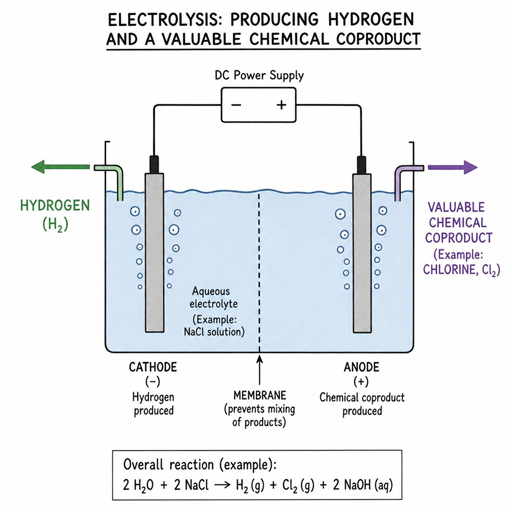
Green hydrogen is often described as a clean fuel for heavy industry, long-duration storage, and future transport systems. A new research direction makes the idea more interesting: instead of producing oxygen as the companion product in electrolysis, the process can produce an epoxide, a valuable industrial chemical used in materials and specialty manufacturing. The result is not simply another hydrogen production technique; it is a fresh way to think about the economics of clean hydrogen and the wider hydrogen economy.
What makes this green hydrogen production method different?
This approach changes what happens alongside hydrogen generation. Conventional electrolysis uses electricity to split water into hydrogen and oxygen, while the Technion-led method couples hydrogen production with epoxide synthesis, replacing the usual oxygen coproduct with a higher-value chemical output. In reported experiments, the researchers achieved 98% efficiency for both hydrogen generation and the parallel epoxide-producing reaction, while also describing the current density as compatible with large-scale industrial electrolysis.
That matters because green hydrogen production is not held back only by chemistry. It is also held back by cost, infrastructure, electricity prices, equipment durability, and the challenge of competing with hydrogen made from fossil fuels. If an electrolyzer can create hydrogen fuel and a useful chemical at the same time, the business case may look different from a system that sells only hydrogen and discards or undervalues oxygen.
The basic problem with conventional electrolysis
Electrolysis is a well-established pathway for hydrogen production. The U.S. Department of Energy describes electrolyzers as devices that use electricity to split water into hydrogen and oxygen, with systems ranging from small distributed units to large central production facilities. When powered by renewable or other low-carbon electricity, electrolysis can produce hydrogen with very low direct emissions, but its economics depend heavily on electricity cost, efficiency, capital cost, and equipment life.
In a standard water-splitting setup, the hydrogen side is the star. The oxygen side is necessary, but it rarely provides comparable commercial value. Oxygen has industrial uses, yet in many green hydrogen conversations it is treated as a low-value byproduct rather than a major revenue driver. That imbalance has pushed researchers to ask a practical question: if electricity is already driving an electrochemical reaction, can the other half of the cell make something more useful?
A review of value-added electrolysis concepts frames this clearly: replacing the oxygen evolution reaction with selective production of useful chemicals could help reduce electrolytic hydrogen costs. It also notes that selectivity, catalyst choice, product separation, electrolyte composition, and life-cycle assessment all matter before laboratory ideas can become practical systems.
Why epoxides are a compelling coproduct
Epoxides are reactive chemical building blocks used in products such as polymers, coatings, adhesives, pharmaceuticals, and other industrial materials, according to the Technion announcement about the new process. Their appeal is not that every hydrogen plant would automatically become a chemical plant overnight. It is that epoxides represent a class of outputs with clearer value than vented or low-margin oxygen.
For green energy systems, that pairing is strategically interesting. Hydrogen energy is often discussed as a storage medium or industrial fuel, while chemical manufacturing is often discussed as a separate decarbonization challenge. A paired process connects the two: renewable electricity can support clean hydrogen generation while also producing a chemical intermediate that industry already understands how to use.
The broader lesson is bigger than one molecule. If green hydrogen production can be integrated with electrosynthesis, electrolyzers may become flexible platforms rather than single-output machines. In the long run, that could encourage more site-specific designs: one plant might prioritize hydrogen for refining or ammonia, while another might pair hydrogen with a chemical that fits nearby demand.
The system-level shift behind the breakthrough
The Technion work is notable because the researchers did not describe the advance as a single better electrode. Dr. Guilin Ruan emphasized that the system combines electrodes, a redox mediator, solvent environment, and operating configuration to make hydrogen and epoxide efficiently without a membrane separating the electrodes.
That is important because electrochemical systems are rarely improved by one component alone. A catalyst may look excellent in isolation but fail when product separation is messy. A solvent may improve selectivity but complicate scale-up. A membrane may protect product purity but add cost, resistance, and maintenance demands. By treating the entire cell as an integrated design problem, researchers can optimize for the practical outcome: useful products, high selectivity, stable operation, and manageable engineering.
The method builds on earlier Technion work in membrane-free and decoupled electrolysis. In these approaches, the hydrogen-producing reaction is separated from the oxygen-producing reaction or replaced with another useful anodic process. Earlier work from the same research ecosystem has also been connected to H2Pro, a company commercializing a related green hydrogen technology.
Where this could fit in the hydrogen economy
The hydrogen economy will not be one single market. It will include industrial feedstocks, backup power, synthetic fuels, steelmaking, fertilizer production, refining, shipping, and seasonal energy storage. The strongest opportunities for clean hydrogen are usually found where direct electrification is difficult, expensive, or technically limited.
A paired hydrogen-and-chemical process could fit best where three conditions overlap:
- Low-carbon electricity is available. The cleaner and cheaper the electricity, the stronger the case for green hydrogen production.
- Hydrogen demand is nearby. Local use can reduce storage, compression, transport, and infrastructure complexity.
- The coproduct has a practical market. Epoxide production only improves economics if the product can be separated, sold, transported, and used reliably.
- Chemical integration is possible. Facilities with existing chemical handling expertise may be better positioned than sites designed only around fuel production.
- Operations can run safely and consistently. Industrial buyers need predictable output, not just promising laboratory performance.
This is why the breakthrough should be viewed as an important research advance rather than an instant replacement for existing hydrogen systems. It suggests a pathway toward better economics, but commercial value will depend on durability, product recovery, safety, scale, permitting, and how well the process fits real supply chains.
Does this make clean hydrogen cheaper?
Potentially, but not automatically. Producing a valuable chemical instead of oxygen could create an additional revenue stream, which may improve the economics of clean hydrogen. However, the published reporting does not prove that the process is already commercially cost-competitive at full scale, and further development is needed to understand long-term operation under industrial conditions.
That distinction matters. A high laboratory efficiency is exciting, especially at a current density described as compatible with large-scale electrolysis. But cost is shaped by more than efficiency. It includes the price of renewable electricity, electrolyzer manufacturing, balance-of-plant equipment, solvents or mediators, product purification, uptime, maintenance, financing, and the market price of both hydrogen and the chemical coproduct.
Still, the economic logic is strong. If a plant can sell clean hydrogen and a valuable epoxide, it may have more ways to recover its investment than a plant that sells hydrogen alone. This could be especially useful in early markets, where hydrogen demand is still developing and buyers are cautious about long-term contracts.
Practical implications for industry and energy planning
For energy planners, the key takeaway is that green hydrogen should not be evaluated only as a fuel. It can also be part of a broader industrial decarbonization platform. The more hydrogen systems can integrate with chemicals, heat, storage, and renewable power, the more useful they may become.
For chemical producers, paired electrolysis points toward a different kind of process design. Instead of treating electricity as merely a utility cost, manufacturers can treat electrons as reagents that drive cleaner synthesis. This aligns with a wider movement toward electrifying chemical production, especially where renewable power is abundant.
For investors and policymakers, the advance reinforces the need to support technologies between the lab and the factory floor. Demonstrations, safety validation, grid integration, and market development are often where promising energy technologies either gain traction or stall.
What to watch next
The next phase will determine whether this method can move from promising science to practical deployment. The most important signals will be concrete and measurable:
- Long-duration operation that shows the cell can maintain efficiency and selectivity over realistic industrial run times.
- Product separation performance that proves the epoxide can be recovered without erasing the economic benefit.
- System safety and reliability across electrodes, solvent environment, mediator chemistry, and operating conditions.
- Techno-economic analysis comparing the full process with conventional hydrogen production and conventional epoxide production.
- Pilot-scale demonstrations that test the process outside ideal laboratory conditions.
If those milestones look positive, this concept could become part of a more flexible clean energy future. Instead of asking green hydrogen to compete on fuel value alone, paired electrosynthesis asks a sharper question: what else can the same electrons make?
A smarter way to think about hydrogen production
The most exciting part of this research is not just that it improves one reaction. It reframes hydrogen production as a platform for making multiple useful outputs from green energy. That could help clean hydrogen become more attractive in markets where cost has slowed adoption.
Green hydrogen still faces real barriers, from electricity prices to infrastructure buildout. But methods that produce hydrogen fuel and valuable chemicals together could make the path more practical. If the technology proves durable and scalable, it may become a meaningful step toward a hydrogen economy that serves both energy and industry.
