
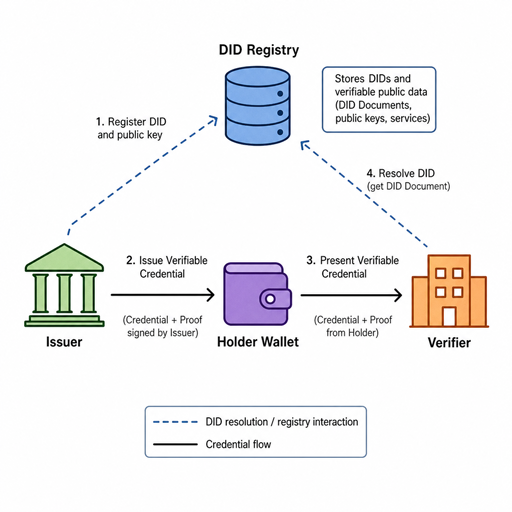
Decentralized identity is a model for proving who someone or something is without making a single platform the permanent gatekeeper of that identity. It combines cryptographic identifiers, verifiable credentials, wallets, policies, and trust frameworks so people, organizations, devices, and AI agents can present proof only when it is needed. For businesses evaluating digital identity solutions, the real opportunity is not “blockchain identity” as a slogan; it is a more portable, privacy-aware approach to identity management and identity authentication.
What does decentralized identity actually mean?
Decentralized identity means an identity subject can use identifiers and credentials that are not fully controlled by one login provider, application, or centralized database. In the W3C model, a Decentralized Identifier, or DID, is a URI made of the did: scheme, a DID method, and a method-specific identifier; the DID resolves to a DID document that can describe cryptographic verification methods and service endpoints. This makes a Decentralized Identity DID useful as a stable, verifiable pointer for people, organizations, software agents, or other entities.
The easiest way to understand the model is to separate identifier, credential, and presentation. A DID identifies a subject. A verifiable credential expresses claims about that subject, such as employment status, age range, account standing, professional license, device integrity, or permission to perform a task. A presentation is what the subject shares with a verifier, ideally revealing only what the verifier needs for the interaction.
That design changes the center of gravity. Traditional identity management often begins with an account inside a company’s system. Decentralized identity begins with proofs that can travel across systems, with trust depending on cryptography, issuer reputation, governance rules, and verification policies rather than a single shared user database.
The building blocks of decentralized identity
A practical decentralized identity system is not one technology. It is a stack of roles, standards, software, and operational policies that must work together.
Decentralized identifiers
DIDs provide a way to associate a subject with public keys, verification methods, and sometimes service endpoints. Different DID methods can use different underlying infrastructure, including ledgers, distributed databases, peer-to-peer mechanisms, or other systems. That flexibility is powerful, but it also means teams must evaluate DID methods carefully rather than assuming all DIDs have the same privacy, governance, cost, or recovery properties.
Verifiable credentials
Verifiable credentials are structured digital credentials that let an issuer make claims that can be cryptographically verified. W3C’s Verifiable Credentials Data Model 2.0 describes a common data model for these credentials and makes clear that verifier trust decisions, such as which issuers to trust for which purposes, are outside the data model itself. In practice, that means the credential format can prove integrity and authorship, but your organization still needs business rules for trust.
Wallets and agents
A wallet stores credentials and helps the holder decide what to share. In consumer settings, this may be a mobile wallet. In enterprise settings, it might be an employee wallet, organizational wallet, device wallet, or automated agent acting under policy. The wallet is where self-sovereign identity becomes tangible: the user or authorized controller can approve, withhold, or limit disclosure.
Issuance and presentation protocols
Standards-based protocols help credentials move between issuers, holders, and verifiers. OpenID for Verifiable Credential Issuance defines an OAuth 2.0-based mechanism for credential issuance and supports W3C verifiable credential formats as well as other credential formats. This matters because decentralized identity will only scale if wallets, issuers, and relying parties can interoperate without custom integrations for every relationship.
Why decentralized identity is gaining momentum
The web’s identity layer was built around accounts, passwords, cookies, and federation. That model made online services usable, but it also created large stores of personal data, repeated onboarding checks, brittle password recovery processes, and dependence on a few identity providers. Decentralized identity responds to those weaknesses by making credentials portable and verification more selective.
Three pressures are pushing the shift:
- Privacy expectations are rising. Users and regulators increasingly expect organizations to collect less data, keep it for shorter periods, and explain why it is needed.
- Fraud is more automated. Attackers can scale account creation, credential stuffing, synthetic identities, and social engineering across many platforms.
- Digital interactions are becoming more agentic. Software agents can search, negotiate, fill forms, initiate workflows, and potentially request payments, which creates a need to verify not only a user but also a delegated actor.
Decentralized identity does not magically solve fraud or compliance. It gives organizations better primitives: cryptographic proof, portable credentials, selective disclosure, revocation checks, and clearer delegation. Those primitives can reduce repeated identity proofing and make identity authentication more context-aware.
How does self-sovereign identity change control?
Self-sovereign identity shifts more control toward the identity subject by allowing credentials to be held and presented from a user-controlled or organization-controlled wallet rather than being constantly fetched from a central profile. The holder can present a proof of a claim, such as “over 18,” “licensed professional,” or “authorized purchasing agent,” without necessarily exposing every attribute in the original credential. The result is a more consent-driven approach to digital identity solutions.
The practical benefit is data minimization. A merchant may need to know that a buyer is eligible for a restricted product, but not their full birth date. An employer’s partner may need to know that a contractor is certified, but not the contractor’s home address. A payments provider may need to know that an agent is authorized for a purchase up to a defined limit, but not the user’s broader account history.
Self-sovereign identity also changes the user experience. Instead of filling the same forms repeatedly, a person can reuse credentials issued by trusted institutions. Instead of creating a new password for each service, the user can rely on wallet-mediated authentication and cryptographic proofs. The long-term promise is fewer accounts, fewer copies of sensitive data, and more explicit control over what is shared.
Traditional identity and decentralized identity compared
|
Area |
Traditional identity management |
Decentralized identity approach |
|---|---|---|
|
Primary anchor |
Account in a service provider database |
DID, credential, wallet, and trust framework |
|
Data sharing |
Often repeated form fills or API lookups |
Holder presents proofs or credentials |
|
Control |
Service provider controls the account record |
Holder controls presentation, issuer controls issuance |
|
Verification |
Passwords, MFA, federation, database checks |
Cryptographic verification plus policy checks |
|
Portability |
Limited across organizations |
Designed for cross-context reuse |
|
Risk |
Centralized data stores become attractive targets |
Wallet compromise, issuer trust, recovery, and governance still matter |
This comparison does not mean one model replaces the other overnight. Most organizations will combine decentralized identity with existing IAM, customer identity, fraud controls, and compliance systems. The near-term pattern is hybrid: decentralized credentials improve onboarding, verification, and delegation while established platforms continue to manage sessions, entitlements, and operational controls.
Use cases that show where the model fits
Decentralized identity is strongest when the same proof needs to be trusted by multiple parties, when privacy matters, and when re-checking the original issuer every time is inefficient.
Customer onboarding
Banks, marketplaces, healthcare portals, and age-restricted services often ask users to prove identity or eligibility. A verifiable credential can reduce duplicate checks if the issuer is trusted and the verifier’s policy accepts the credential. This can make onboarding smoother while limiting how much raw personal data the business stores.
Workforce and partner access
Enterprises can issue credentials for employment, training, device status, role, or contractor approval. A partner system can verify those credentials before granting access to a portal or workflow. This is especially useful when people move across projects, subsidiaries, vendors, or temporary roles.
Education and professional credentials
Schools, certification bodies, and licensing organizations can issue credentials that learners or professionals present to employers, platforms, or regulators. The verifier can check the credential’s integrity and issuer without relying on screenshots, PDFs, or manual emails.
Devices, services, and AI agents
DIDs are not limited to humans. Devices, APIs, bots, and AI agents can also need durable identifiers and verifiable permissions. As autonomous systems act across organizational boundaries, decentralized identity can help answer: what is this agent, who controls it, what is it allowed to do, and has that authorization been revoked?
Decentralized identity DID for AI agents in payments
The phrase “decentralized identity did for ai agents in payments” points to one of the most important emerging identity problems: how to let software act for a person or business without giving it unlimited access. Agentic payments require proof of identity, proof of authorization, transaction constraints, and auditability. FIDO Alliance work on agentic AI focuses on phishing-resistant user authorization, approved agent actions, and verifiable transaction boundaries for commerce and payment flows.
In a payment scenario, a user might authorize an agent to buy a flight under a maximum price, within a date range, using a specific payment method. The agent would need a verifiable delegation rather than the user’s raw credentials. A merchant or payment processor could then check the agent identity, the user’s authorization, the transaction limits, and the payment credential before accepting the request.
Early agentic payment specifications are moving in this direction. Visa’s Trusted Agent Protocol describes objects and signatures intended to link agentic payment content to signed requests, while the Agent Payments Protocol documentation describes roles such as credential providers that manage user payment and identity credentials. These are signs of a broader trend: payments will need identity layers that can distinguish a legitimate delegated agent from a spoofed bot.
Benefits and trade-offs to understand before adopting
Decentralized identity offers meaningful advantages, but it is not a shortcut around trust, security, or governance.
Key benefits
- Reduced data exposure: Verifiers can request only the claims needed for a transaction.
- Credential portability: Holders can reuse trusted credentials across multiple services.
- Better delegation: People and organizations can authorize agents or representatives with scoped permissions.
- Stronger proof integrity: Cryptographic signatures make tampering detectable.
- Improved user experience: Reusable credentials can reduce repetitive onboarding and manual document checks.
Key trade-offs
- Wallet recovery is hard: If a user loses wallet access, recovery must be secure without becoming an attack path.
- Issuer trust is still essential: A valid credential from an untrusted issuer may not be useful.
- Revocation and status checks need design: Verifiers need reliable ways to know whether a credential remains valid.
- Interoperability is uneven: Standards are maturing, but product implementations can still differ.
- Privacy depends on implementation: Poor correlation controls can allow activity tracking across contexts.
The lesson is simple: decentralized identity improves the building blocks, but architecture decides the outcome.
How should organizations plan for adoption?
Organizations should begin with a specific verification problem, not with a broad mandate to “use decentralized identity.” The best starting point is a workflow where identity proof is repeated, expensive, privacy-sensitive, or difficult to trust across parties. From there, teams can map the issuers, holders, verifiers, policies, risks, and user experience.
Use this checklist before choosing platforms or protocols:
- Define the claim. What exactly must be proven: identity, age, employment, authorization, device state, account ownership, or payment permission?
- Identify trusted issuers. Which organizations are allowed to issue that claim, and under what governance model?
- Choose the holder experience. Will credentials live in consumer wallets, enterprise wallets, device wallets, or server-side agents?
- Set verifier policy. What credential formats, issuers, assurance levels, expiration rules, and revocation methods will be accepted?
- Plan recovery and lifecycle. How are credentials renewed, revoked, rotated, suspended, or reissued?
- Integrate with current IAM. Decide where decentralized credentials fit with SSO, MFA, risk engines, fraud tools, and audit logs.
- Measure privacy impact. Collect only what the workflow requires and avoid identifiers that enable unnecessary tracking.
NIST’s SP 800-63-4 remains useful here because it frames digital identity around risk assessment, assurance levels, identity proofing, authentication, and federation. Even when using decentralized credentials, organizations still need to decide how much assurance a transaction requires and which controls satisfy that risk.
The future is hybrid, verifiable, and policy-driven
The future of decentralized identity will likely be practical rather than ideological. Companies will not abandon existing identity management systems all at once. Instead, they will add verifiable credentials where portability, privacy, and cross-party trust create measurable value.
Expect adoption to grow first in high-friction workflows: regulated onboarding, workforce verification, education credentials, supply chain attestations, delegated enterprise access, and agentic commerce. In these contexts, the value is not only user control. It is the ability to make a claim portable, prove it cryptographically, limit disclosure, and enforce policy at the moment of use.
For leaders evaluating digital identity solutions, the best question is not whether decentralized identity will replace every login. The better question is where verifiable, user-mediated, and machine-readable proof can remove friction or reduce risk. That is where decentralized identity becomes less of a future concept and more of an operating layer for trusted digital interaction.
