
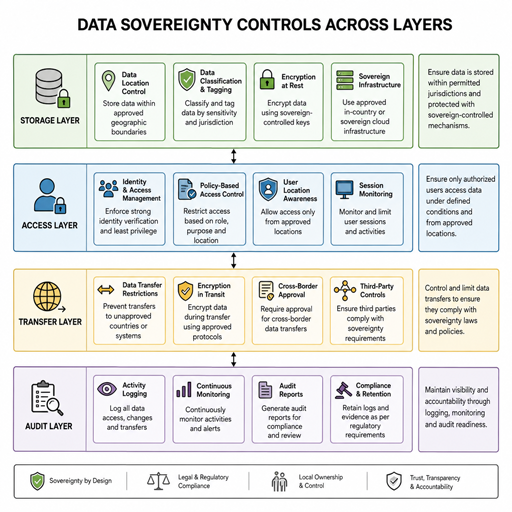
Data Sovereignty Compliance is the practice of making sure data is stored, accessed, transferred, and governed according to the laws of the jurisdiction that has authority over it. In simple terms, it answers a business-critical question: where does data live, who can touch it, and which compliance regulations apply when it moves? For organizations operating across countries, cloud regions, mobile networks, connected devices, or global customer bases, it is a core part of regulatory compliance—not a narrow IT setting.
What does Data Sovereignty Compliance mean?
Data Sovereignty Compliance means aligning data handling practices with the legal, contractual, and operational requirements of the country, region, or sector that governs the data. It goes beyond choosing a server location. A compliant approach considers the full data lifecycle: collection, storage, processing, support access, backup, transfer, deletion, auditability, and third-party involvement.
This matters because modern data rarely stays in one place. A customer record may be collected in one country, processed by a cloud service in another, viewed by support staff elsewhere, and backed up in multiple regions. Data privacy laws and cross-border transfer rules can apply at each stage. For example, the GDPR sets conditions for transferring personal data outside the European Economic Area, including adequacy decisions and appropriate safeguards such as standard contractual clauses or binding corporate rules.
For teams researching topics such as cubic telecom regulatory compliance data sovereignty, the practical issue is usually not just “where is the database?” It is whether connectivity, platform operations, SIM or device data, customer data, and analytics workflows are mapped to the right jurisdictional obligations.
Defining characteristics of data sovereignty
A useful definition of data sovereignty includes several connected elements. If one is missing, the organization may have data residency without true sovereignty controls.
- Jurisdictional control: Data is subject to the laws and legal processes of a country, region, or authority.
- Location awareness: The organization knows where regulated data is stored, replicated, backed up, and processed.
- Access governance: Administrative, support, vendor, and employee access is controlled, logged, and limited by policy.
- Transfer management: Cross-border movement is assessed before it happens, especially for personal, sensitive, government, telecom, financial, or health data.
- Contractual alignment: Customer contracts, vendor agreements, and cloud terms reflect the required controls.
- Audit evidence: The organization can prove how data is classified, protected, accessed, retained, and deleted.
- Ongoing monitoring: Rules are reviewed as laws, business operations, cloud architectures, and service providers change.
These characteristics show why data sovereignty is not a one-time legal review. It is a governance model that connects legal, compliance, security, procurement, product, and infrastructure teams.
How do data residency requirements differ from data sovereignty?
Data residency requirements focus on where data must be stored or processed. Data sovereignty focuses on which laws and authorities apply to the data, including who can access it and under what legal conditions. The two ideas often overlap, but they are not identical.
A data residency rule may require certain data to remain in a specific country or approved region. For example, some government cloud requirements restrict where government data can be stored, such as rules requiring certain U.S. Department of Defense cloud data to be maintained within the United States or outlying areas unless otherwise authorized.
Data sovereignty asks a broader question. Even if data is stored in the right country, could a foreign parent company, outsourced support team, or cross-border system administrator access it? Are encryption keys controlled locally? Are logs, backups, telemetry, and disaster recovery copies also covered? These are sovereignty questions, not only residency questions.
|
Concept |
Main question |
Practical focus |
|---|---|---|
|
Data residency |
Where is the data physically or logically stored? |
Cloud region, hosting location, backup location, processing location |
|
Data sovereignty |
Which laws and authorities govern the data? |
Jurisdiction, access, legal demands, ownership, operational control |
|
Data localization |
Must the data remain inside a specific country? |
Local storage mandates, restricted transfers, in-country processing |
|
Data privacy compliance |
Are individuals’ rights and data protection duties respected? |
Consent, lawful basis, notice, minimization, security, deletion |
The distinction is important because buying a local cloud region does not automatically satisfy all compliance frameworks. A company still needs policies, contracts, technical controls, and evidence that match the relevant compliance regulations.
Why data sovereignty matters for regulatory compliance
Data sovereignty matters because digital operations are increasingly distributed. Businesses use global cloud platforms, SaaS tools, analytics vendors, customer support teams, mobile networks, payment processors, and device ecosystems. Each relationship can introduce a new data location, transfer path, or access risk.
Data privacy laws usually focus on protecting individuals, but sovereignty requirements can also protect national interests, government information, critical infrastructure, financial stability, telecom networks, and sector-specific records. That is why compliance programs must look beyond privacy notices. They need a clear view of operational reality.
Strong Data Sovereignty Compliance can help organizations:
- Reduce regulatory exposure by identifying where regulated data is located and which obligations apply.
- Improve customer trust by explaining how data is protected across regions and vendors.
- Support enterprise sales by answering procurement and security questionnaires with evidence instead of assumptions.
- Strengthen incident response by knowing which regulators, customers, contracts, and jurisdictions may be affected.
- Enable global growth by building repeatable controls for new markets, products, and cloud deployments.
Frameworks can help structure this work. The NIST Privacy Framework is designed as an enterprise risk management tool for privacy risks, and it supports governance activities such as identifying data processing, assessing risks, and managing privacy outcomes. ISO/IEC 27701 also provides requirements and guidance for establishing, implementing, maintaining, and improving a privacy information management system.
What types of data are usually affected?
Data sovereignty concerns can apply to many kinds of information, but some categories deserve special attention because they are more likely to be regulated, contractually restricted, or operationally sensitive.
Common examples include:
- Personal data: names, contact details, identifiers, location data, account records, and online identifiers.
- Sensitive personal data: health information, biometric data, financial details, children’s data, or information revealing protected characteristics.
- Government data: public-sector records, defense-related information, citizen services data, and regulated workloads.
- Telecommunications data: subscriber records, network usage information, device identifiers, roaming data, and connectivity metadata.
- Financial and payment data: transaction records, account information, fraud signals, and audit logs.
- Operational technology and IoT data: sensor data, device status, location signals, fleet activity, and machine telemetry.
- Security data: logs, authentication records, threat intelligence, encryption keys, and access histories.
Not every data element carries the same risk. A public product brochure is different from a customer identity document, and aggregated analytics may be different from raw user-level location records. The first step is to classify data accurately so controls match the sensitivity and jurisdictional requirements.
How does a compliance program manage sovereignty risk?
A compliance program manages sovereignty risk by translating legal and contractual requirements into everyday operating controls. The goal is not to freeze data in place. The goal is to make data movement intentional, documented, protected, and defensible.
A practical program usually includes the following steps:
- Map the data lifecycle. Identify what data is collected, where it originates, where it is stored, where it is processed, who can access it, and where backups or logs are kept.
- Classify data by sensitivity and jurisdiction. Tag regulated data so teams know which rules apply before they build, migrate, or share systems.
- Identify applicable data privacy laws and sector rules. Review privacy, telecom, financial, health, government, cloud, export, and contractual requirements where relevant.
- Define data residency requirements. Decide which data must stay in a specific region, which can move under safeguards, and which should be anonymized, minimized, or excluded.
- Control access. Use role-based permissions, privileged access management, logging, monitoring, and approval workflows for cross-border support or administration.
- Review vendors and subprocessors. Confirm where vendors store and process data, what subcontractors they use, and what transfer mechanisms or contractual protections apply.
- Protect data technically. Apply encryption, key management, segmentation, retention rules, deletion workflows, and secure backup designs.
- Maintain evidence. Keep records of decisions, policies, data maps, assessments, contracts, audit logs, and training.
- Monitor change. Reassess requirements when entering new markets, launching products, changing vendors, or redesigning infrastructure.
This approach makes compliance less dependent on memory or informal approvals. It creates a repeatable operating model that can support audits, customer reviews, and internal decision-making.
Practical examples and common misconceptions
Data sovereignty is easier to understand when it is tied to real operating situations. These examples show how the concept appears in everyday business decisions.
- Cloud region selection: A company may choose a regional cloud deployment to satisfy customer expectations or regulatory commitments, but it must also check backup, support, and logging locations.
- Customer support access: Support staff in another country may need to view account records. The organization must decide whether that access is permitted, restricted, logged, or routed through approved teams.
- Connected device platforms: IoT data may include device identifiers, location, usage patterns, and network metadata. Sovereignty controls should cover ingestion, connectivity management, analytics, and retention.
- Mergers and vendor changes: A new parent company, subcontractor, or platform migration can change who has access to data and which laws may apply.
- Analytics projects: Data used for reporting may still be regulated if it can identify people, devices, accounts, or locations.
Misconceptions are common. One is that data sovereignty is solved by selecting a local data center. Another is that encrypted data is automatically outside the scope of regulation. A third is that only personal data matters. In reality, compliance regulations may also apply to government records, telecom metadata, critical infrastructure data, contractual data, or confidential business information.
Compliance frameworks turn requirements into controls
Compliance frameworks help organizations move from broad obligations to specific controls. They do not replace legal analysis, but they make governance more consistent. A framework can define who owns data decisions, how risk is assessed, what evidence is collected, and how controls are tested over time.
For Data Sovereignty Compliance, useful framework elements include:
- Governance: named owners, policies, escalation paths, and approval processes.
- Inventory: systems, data categories, storage locations, vendors, and transfer paths.
- Risk assessment: evaluation of legal, operational, security, and business risks.
- Security controls: encryption, identity management, logging, monitoring, and incident response.
- Privacy controls: lawful basis, notices, minimization, retention, rights handling, and transfer safeguards.
- Vendor management: due diligence, contractual terms, subprocessors, and audit rights.
- Assurance: internal reviews, control testing, customer evidence packs, and audit readiness.
The best framework is the one the organization can actually operate. A global enterprise may need mature tooling and regional control models. A growing company may begin with a clear inventory, vendor review process, access controls, and documented transfer decisions.
A practical checklist for getting started
Organizations do not need to solve every sovereignty issue at once. They should start with the highest-risk data, markets, customers, and vendors, then expand the program as operations mature.
Use this checklist as a starting point:
- Identify the countries and regions where customers, users, employees, devices, or regulated operations are located.
- List the systems that collect, store, process, transmit, back up, or analyze regulated data.
- Document where primary data, replicas, logs, backups, and analytics datasets are hosted.
- Review contracts for data residency requirements, transfer clauses, audit rights, and vendor obligations.
- Confirm which employees, vendors, administrators, and support teams can access regulated data.
- Define rules for cross-border transfers, remote access, emergency support, and data exports.
- Apply encryption and key management controls that match the sensitivity of the data.
- Set retention and deletion rules so data is not kept longer than needed.
- Train product, engineering, legal, procurement, and customer-facing teams on the approval process.
- Review the program regularly as regulations, services, customers, and infrastructure change.
This checklist should be adapted to the organization’s size, sector, and risk profile. It is also wise to involve qualified legal and compliance professionals when interpreting specific laws or customer obligations.
The bottom line
Data Sovereignty Compliance is about control, accountability, and proof. It ensures that data is handled according to the jurisdictional, privacy, security, and contractual rules that apply to it. Data residency requirements are part of the picture, but true sovereignty also depends on access controls, transfer safeguards, vendor oversight, evidence, and ongoing governance.
As data privacy laws and digital infrastructure continue to evolve, organizations that treat sovereignty as a living compliance discipline will be better prepared for audits, customer scrutiny, market expansion, and regulatory change. The safest starting point is simple: know your data, know where it goes, know who can access it, and keep evidence that your controls match your obligations.
